Categories
Uncategorized

LIFE’S PRETENDERS/& DECEIVERS

I was on my way home one Monday afternoon while returning from a routine trip to Berekum. As soon as I arrived on Yonko Paa Street, my residence, I saw an enormous blanket of large flies covering my path. Apparently, I was in the throes of a supernatural premonition. I knew exactly what it meant. I was about to do something extremely foolish. Someone that I knew was plotting to weaponize my lofty Christian idealism and magnanimity to rob me. I was in danger of succumbing to his trick because of who I am. I didn’t have to wait long to understand the whole meaning of this revelation. While passing through the gates of my domicile, I saw a stranger on my porch attaching an electrical wire to the outlet stationed there. “What’s going on?” I inquired. A gentleman that I knew approached me from behind. Coming from a house in front of my home that was under construction. “Brother James,” he commenced, “I was trying to call you, unsuccessfully. All I’m trying to do is get a little power to do a small amount of work in the house over there.” How long will this take,” I inquired. “Oh, only a few minutes,” was his reply. Although I heard his words, the warning I had received from The Holy Spirit was paramount in my mind.

Over the years, I have learned that people never reveal the full ramifications of their intended mischief. I had also learned to listen without question to orders issued by The Holy Ghost. Accordingly, I got on the phone and called a trusted electrician. “Sir, do you remember me?” I asked. “Yes, of course,” was his reply. “How can I help you?” he continued. “I need you to come to my house as soon as possible to disable an electrical receptacle on my front porch,” I explained. “O.K., I will be there by 7:00 A.M. tomorrow morning,” he replied. I thanked him and discontinued the call. As promised, he was at my house on time the following morning. He promptly deactivated the outlet, I paid him fifty cedis (US$3.00), and he left. As I had feared, those two people were back at my house that same afternoon. They intended to repeat the same trick that they pulled the previous day. I saw someone on my porch attempting to make the same connections, but that outlet had no power. I heard my phone ringing, and I didn’t answer it. Such is life. Unscrupulous people always try to take shortcuts at the expense of others. That’s one of the reasons that The Master warned, “Behold, I send you out as sheep in the midst of wolves. Therefore be wise as serpents and harmless as doves.” Matthew 10:16 (NKJV). 

The fact that Almighty God faithfully provides for and blesses those who love and obey Him in a world of sin is no carefully guarded secret. Nor is it nuclear science that Satan’s followers prey upon God’s servants to be beneficiaries of such divine beneficence. This fact has been unfolding before us since ancient times.

Then Isaac departed from there and pitched his tent in the Valley of Gerar, and dwelt there. And Isaac dug again the wells of water which they had dug in the days of Abraham his father, for the Philistines had stopped them up after the death of Abraham. He called them by the names which his father had called them. Also Isaac’s servants dug in the valley, and found a well of running water there. But the herdsmen of Gerar quarreled with Isaac’s herdsmen, saying, “The water is ours.” So he called the name of the well Esek, because they quarreled with him. Then they dug another well, and they quarreled over that one also. So he called its name Sitnah. And he moved from there and dug another well, and they did not quarrel over it. So he called its name Rehoboth, because he said, “For now the Lord has made room for us, and we shall be fruitful in the land.” Then he went up from there to Beersheba. And the Lord appeared to him the same night and said, “I am the God of your father Abraham; do not fear, for I am with you. I will bless you and multiply your descendants for My servant Abraham’s sake.” So he built an altar there and called on the name of the Lord, and he pitched his tent there; and there Isaac’s servants dug a well.Genesis 26:17-25 (NKJV)

This record in scripture reveals God’s constant protection and care over His servants and an indirect extension of such mercy and compassion to those who are servants of the arch-deceiver. The Philistines became recipients of the same blessings extended to God’s servants by the very presence of His children. Therefore, it is paramount that God’s servants become great exemplars of godliness and virtue. Not only because of the blessing that will be poured upon them when they glorify God by virtuous lives. But also because of the multiplying effect on the children of darkness. The pagans amongst whom he lived and raised his livestock knew that Isaac received divine provision and protection. Because his servants could find water where the Philistines hadn’t been able to find any. Accordingly, they decided it was in their best interest to live peaceably with him and cultivate his goodwill and friendship.

“Then Abimelech came to him from Gerar with Ahuzzath, one of his friends, and Phichol the commander of his army. And Isaac said to them, “Why have you come to me, since you hate me and have sent me away from you?” But they said, “We have certainly seen that the Lord is with you. So we said, ‘Let there now be an oath between us, between you and us; and let us make a covenant with you, that you will do us no harm, since we have not touched you, and since we have done nothing to you but good and have sent you away in peace. You are now the blessed of the Lord.’ ” So he made them a feast, and they ate and drank. Then they arose early in the morning and swore an oath with one another; and Isaac sent them away, and they departed from him in peace. It came to pass the same day that Isaac’s servants came and told him about the well which they had dug, and said to him, “We have found water.” So he called it Shebah. Therefore the name of the city is Beersheba to this day.” Genesis 26:26-32 (NKJV)

(TO BE CONTINUED)
Categories
Uncategorized

WHO IS THE BEAST OF REVELATION 13?: THEOLOGICAL ABUSES BY THE PAPACY (CONTINUED)

INDULGENCE, a distinctive feature of the penitential system of both the Western medieval and the Roman Catholic Church that granted full or partial remission of the punishment of sin. The granting of indulgences was predicated on two beliefs. First, in the sacrament of PENANCE it did not suffice to have the guilt (culpa) of sin forgiven through absolution alone; one also needed to undergo temporal punishment (poena, from p[o]enitentia, “penance”) because one had offended Almighty God. Second, indulgences rested on belief in purgatory, a place in the next life where one could continue to cancel the accumulated debt of one’s sins, another Western medieval conception not shared by Eastern Orthodoxy or other Eastern Christian churches not recognizing the primacy of the pope.

From the early church onward, bishops could reduce or dispense with the rigours of penances, but indulgences emerged in only the 11th and 12th centuries when the idea of PURGATORY took widespread hold and when the popes became the activist leaders of the reforming church. In their zeal, they promoted the militant reclamation of once-Christian lands—first of Iberia in the Reconquista, then of the Holy Land in the Crusades—offering “full remission of sins,” the first indulgences, as inducements to participation. BRITANNICA: Indulgence, Roman Catholicism By Lawrence G. Duggan, November 29, 2024.

The Bible teaches that there is resultant punishment for sin in this life and at the judgment.“Behold, all souls are Mine; The soul of the father
As well as the soul of the son is Mine; The soul who sins shall die.
Ezekiel 18:4 (NKJV)

This divine decree is not executed immediately. Sinners are given the opportunity to repent and reform and live lives devoted to righteousness.

But if a man is just And does what is lawful and right; If he has not eaten on the mountains, Nor lifted up his eyes to the idols of the house of Israel, Nor defiled his neighbor’s wife, Nor approached a woman during her impurity; If he has not oppressed anyone, But has restored to the debtor his pledge; Has robbed no one by violence,
But has given his bread to the hungry And covered the naked with clothing; If he has not exacted usury Nor taken any increase,
But has withdrawn his hand from iniquity And executed true judgment between man and man; If he has walked in My statutes And kept My judgments faithfully—He is just; He shall surely live!”
Says the Lord God.
Ezekiel 18:5-9 (NKJV).

Furthermore, all are admonished to turn away from a life of unrighteousness in order to avoid God’s retributive judgments.

“If he begets a son who is a robber Or a shedder of blood, Who does any of these things And does none of those duties,
But has eaten on the mountains Or defiled his neighbor’s wife; If he has oppressed the poor and needy, Robbed by violence, Not restored the pledge, Lifted his eyes to the idols, Or committed abomination; If he has exacted usury Or taken increase—Shall he then live? He shall not live! If he has done any of these abominations, He shall surely die;
His blood shall be upon him.”
Ezekiel 18:10-13 (NKJV).

Nowhere, in scripture however, do we read that humans have any control over this process. The manifold providences of God reveal His displeasure and exact His judgments.

“Is this not laid up in store with Me, Sealed up among My treasures?
Vengeance is Mine, and recompense; Their foot shall slip in due time;
For the day of their calamity is at hand, And the things to come hasten upon them.”
Deuteronomy 32:34-35 (NKJV)

There are no Bible passages that teach or uphold any kind of belief in Indulgences, Penance, or Purgatory. Such teachings are based upon human works. In fact it is made very clear in the book of Job that human righteousness while commendable and pleasing to God will count for nothing in the process of salvation. Man who is a reprobate sinner desperately needs a SAVIOUR.

“Moreover the Lord answered Job, and said: Shall the one who contends with the Almighty correct Him? He who rebukes God, let him answer it.”

Job’s Response to God

Then Job answered the Lord and said: Behold, I am vile; What shall I answer You? I lay my hand over my mouth. Once I have spoken, but I will not answer; Yes, twice, but I will proceed no further.” Job 40:1-5 (NKJV)

God declares His Sovereignty, Majesty, and power:

“Would you indeed annul My judgment? Would you condemn Me that you may be justified? Have you an arm like God? Or can you thunder with a voice like His?  Then adorn yourself with majesty and splendor,
And array yourself with glory and beauty. Disperse the rage of your wrath; Look on everyone who is proud, and humble him. Look on everyone who is proud, and bring him low; Tread down the wicked in their place. Hide them in the dust together, Bind their faces in hidden darkness. Then I will also confess to you That your own right hand can save you.” Job 40:8-14 (NKJV).

Then Job answered the Lord and said:

 “I know that You can do everything, And that no purpose of Yours can be withheld from You. You asked, ‘Who is this who hides counsel without knowledge?’ Therefore I have uttered what I did not understand, Things too wonderful for me, which I did not know.
Listen, please, and let me speak; You said, ‘I will question you, and you shall answer Me.’  “I have heard of You by the hearing of the ear,
But now my eye sees You. Therefore I abhor myself,
And repent in dust and ashes.”
Job 42:1-6 (NKJV).

Job finally comes to the realization and acknowledges that he is just another vile sinner in desperate need of a divine SAVIOUR. To bring him to this vital truth was the whole purpose of his terribly psychic and traumatic ordeal.

Categories
Uncategorized

WHO IS THE BEAST OF REVELATION 13: THEOLOGICAL ABUSES BY THE PAPACY

As the centuries progressed from the commencement of the early Christian Church, several practices developed within The Roman Catholic Communion, which were patently unscriptural. One such practice was Nepotism. The act of conferring upon a close relative an important position or office within the church. Even though other, more qualified candidates were available. For this reason, such an appointee was clearly unqualified. Another unbiblical practice was Simony. The act of selling a sacred office to anyone with the money to purchase it. This practice was named after Simon, the sorcerer who attempted to purchase the Holy Spirit for a price from The Apostle Peter.

“And when Simon saw that through the laying on of the apostles’ hands the Holy Spirit was given, he offered them money,  saying, “Give me this power also, that anyone on whom I lay hands may receive the Holy Spirit.” But Peter said to him, “Your money perish with you, because you thought that the gift of God could be purchased with money! You have neither part nor portion in this matter, for your heart is not right in the sight of God. Repent therefore of this your wickedness, and pray God if perhaps the thought of your heart may be forgiven you.  For I see that you are poisoned by bitterness and bound by iniquity.” Then Simon answered and said, ‘Pray to the Lord for me, that none of the things which you have spoken may come upon me.'” Acts 8:18-24 (NKJV)

Eventually, The Papacy started claiming it had the power to forgive sins. Such power, it claimed, it has conferred upon every officiating priest. On the contrary, however, Such authority was never bestowed upon any human by The Saviour. Who alone is our glorious High Priest. Therefore, every penitent and repentant sinner must pray to Christ Himself for the absolution of all his sins.

“If we say that we have no sin, we deceive ourselves, and the truth is not in us. If we confess our sins, He is faithful and just to forgive us our sins and to cleanse us from all unrighteousness.” 1John 1:8-9 (NKJV).

“Seeing then that we have a great High Priest who has passed through the heavens, Jesus the Son of God, let us hold fast our confession. For we do not have a High Priest who cannot sympathize with our weaknesses, but was in all points tempted as we are, yet without sin. Let us therefore come boldly to the throne of grace, that we may obtain mercy and find grace to help in time of need.” Hebrews 4:14-16 (NKJV)

It is of great significance to note that no time in the New Testament did any disciple or apostle claim to have the authority to forgive sins. Such claims were made exclusively by The Son of God. Furthermore, not even in The Old Testament did the Aaronic High Priest or any subordinate cleric make any such claim. The forgiveness of sins was a promise made solely by God Himself if certain conditions were fulfilled by the transgressor. Every penitent sinner who brought an animal sacrifice. Confessed his sins upon the head of the substitutionary sacrifice and then slaughtered the animal himself at the door of the Tabernacle of Meeting.

“If anyone of the common people sins unintentionally by doing something against any of the commandments of the Lord in anything which ought not to be done, and is guilty, or if his sin which he has committed comes to his knowledge, then he shall bring as his offering a kid of the goats, a female without blemish, for his sin which he has committed. And he shall lay his hand on the head of the sin offering, and kill the sin offering at the place of the burnt offering. Then the priest shall take some of its blood with his finger, put it on the horns of the altar of burnt offering, and pour all the remaining blood at the base of the altar. He shall remove all its fat, as fat is removed from the sacrifice of the peace offering; and the priest shall burn it on the altar for a sweet aroma to the Lord. So the priest shall make atonement for him, and it shall be forgiven him.” Leviticus 4:27-31 (NKJV)

At all times, the animal being sacrificed represented Christ, our Redeemer. Who would one day come into our world to die upon Calvary’s Tree for the sins of the human race? The penitent sinner placed his hands on the animal’s head before taking its life because Christ is our sin-bearer.

“But He was wounded for our transgressions, He was bruised for our iniquities; The chastisement for our peace was upon Him, And by His stripes we are healed. All we like sheep have gone astray;
We have turned, every one, to his own way; And the Lord has laid on Him the iniquity of us all.”
Isaiah 53:5-6 (NKJV)

(TO BE CONTINUED)

Categories
Uncategorized

WHO IS THE BEAST OF REVELATION 13: OUTRAGEOUS CLAIMS BY THE PAPACY

And he was given a mouth speaking great things and blasphemies, and he was given authority to continue for forty-two months. Then he opened his mouth in blasphemy against God, to blaspheme His name, His tabernacle, and those who dwell in heaven. Revelation 13:5-6 (NKJV).

I was considering the horns, and there was another horn, a little one, coming up among them, before whom three of the first horns were plucked out by the roots. And there, in this horn, were eyes like the eyes of a man, and a mouth speaking pompous words. Daniel 7:8 (NKJV).

“The Pope is of so great dignity, and so exalted that he is not a mere man, but as it were God. and the vicar of God.”
Ferraris Ecclesiastical dictionary

“All names which in the Scriptures are applied to Christ, by virtue of which it is established that He is over the church, all the same names are applied to the Pope.”
On the Authority of the Councils, book 2, chapter 17

“The Pope and God are the same, so he has all power in Heaven and earth.”
Pope Pius V, quoted in Barclay, Chapter XXVII, p. 218, “Cities Petrus Bertanous”.”…the Pope is as it were God on earth, sole sovereign of the faithful of Christ, chief of kings, having plenitude of power.”
Lucius Ferraris, in “Prompta Bibliotheca Canonica, Juridica, Moralis, Theologica, Ascetica, Polemica, Rubristica, Historica”, Volume V, article on “Papa, Article II”, titled “Concerning the extent of Papal dignity, authority, or dominion and infallibility”, #1, 5, 13-15, 18, published in Petit-Montrouge (Paris) by J. P. Migne, 1858 edition.

“The Pope takes the place of Jesus Christ on earth…by divine right the Pope has supreme and full power in faith, in morals over each and every pastor and his flock. He is the true vicar, the head of the entire church, the father and teacher of all Christians. He is the infallible ruler, the founder of dogmas, the author of and the judge of councils; the universal ruler of truth, the arbiter of the world, the supreme judge of heaven and earth, the judge of all, being judged by no one, God himself on earth.” Quoted in the New York Catechism.

These words are written in the Roman Canon Law 1685: “To believe that our Lord God the Pope has not the power to decree as he is decreed, is to be deemed heretical.”Father A. Pereira says: “It is quite certain that Popes have never approved or rejected this title ‘Lord God the Pope,’ for the passage in the gloss referred to appears in the edition of the Canon Law published in Rome in 1580 by Gregory XIII.”

Writers on the Canon Law say, “The Pope and God are the same, so he has all power in heaven and earth.”
Barclay Cap. XXVII, p. 218. Cities Petrus Bertrandus, Pius V. – Cardinal Cusa supports his statement.

Pope Nicholas I declared: “the appellation of God had been confirmed by Constantine on the Pope, who, being God, cannot be judged by man.”
Labb IX Dist.: 96 Can. 7, Satis evidentur, Decret Gratian Primer Para.

“The pope is of so great dignity and so exalted that he is not a mere man …. he is as it were God on earth, sole sovereign of the faithful of Christ, chief of kings, having plenitude of power.” Lucius Ferraris, «Prompta Bibliotheca», 1763, Volume VI, ‘Papa II’, pp.25-29

“The supreme teacher in the Church is the Roman Pontiff. Union of minds, therefore, requires… complete submission and obedience of will to the Church and to the Roman Pontiff, as to God Himself.”
Leo VIII, «On the Chief Duties of Christians as Citizens», Encyclical letter, 1890

“God separates those whom the Roman Pontiff, who exercises the functions, not of mere man, but of the true God…dissolves, not by human but rather by divine authority.”
Decretals of Gregory IX», Book 1, Chapter 7.3

“Hence the Pope is crowned with a triple crown, as king of heaven and of earth and of the lower regions (infernorum).”
Lucius Ferraris, «Prompta Bibliotheca», 1763, Volume VI, ‘Papa II’, p.26)

“Innocent III has written: “Indeed, it is not top much to say that in view of the sublimity of their offices the priests are so many gods.”
The dignity of the priesthood by Liguori p, 36

“The Pope is not only the representative of Jesus Christ, he is Jesus Christ himself, hidden under the veil of flesh.”
Catholic National July 1895

“We hold upon this earth the place of God Almighty”
Pope Leo XIII Encyclical Letter of June 20, 1894

All the faithful must believe that the Holy Apostolic See and the Roman Pontiff [the Pope] possesses the primacy over the whole world, and the Roman Pontiff is the successor of blessed Peter, Prince of the Apostles, and is true vicar of Christ, and heed of the whole church, and father and teacher of all Christians; and that full power was given to him in blessed Peter to rule, feed, and govern the universal Church by Jesus Christ our Lord.”
First Dogmatic Constitution on the Church of Christ, “Eternal Pastor,” published in the fourth session of the Vatican Council, 1870, chap. 3, in Philip Schaff, Creeds of Christendom. vol. 2, p. 262.

“The Pope’s authority is unlimited, incalculable; it can strike, as Innocent III says, wherever sin is; it can punish every one; it allows no appeal and is itself Sovereign Caprice; for the Pope carries, according to the expression of Boniface VIII, all rights in the Shrine of his breast. As he has now become infallible, he can by the use of the little word, “orbi,” (which means that he turns himself round to the whole Church) make every rule, every doctrine, every demand, into a certain and incontestable article of Faith. No right can stand against him, no personal or corporate liberty; or as the [Roman Catholic] Canonists put it—“The tribunal of God and of the pope is one and the same.”
Ignaz von Dollinger, “A Letter Addressed to the Archbishop of Munich” 1871; as quoted in MacDougall,

“The Saviour Himself is the door of the sheepfold: ‘I am the door of the sheep.’ Into this fold of Jesus Christ, no man may enter unless he be led by the Sovereign Pontiff; and only if they be united to him can men be saved, for the Roman Pontiff is the Vicar of Christ and His personal representative on earth.”
(Pope John XXIII in his homily to the Bishops and faithful assisting at his coronation on November 4, 1958).

All of these ridiculous and outrageous claims made over several centuries of time by the Papacy are not only a fulfilment of prophecy they are also contrary to the plain teachings of scripture.

“And so we have the prophetic word confirmed, which you do well to heed as a light that shines in a dark place, until the day dawns and the morning star rises in your hearts;  knowing this first, that no prophecy of Scripture is of any private interpretation, for prophecy never came by the will of man, but holy men of God spoke as they were moved by the Holy Spirit.” 2 Peter 1:19-21(NKJV).

“And God spoke all these words, saying: ‘I am the Lord your God…You shall have no other gods before Me.'” Exodus 20:1-3 (NKJV)

Do not put your trust in princes, Nor in a son of man, in whom there is no help. His spirit departs, he returns to his earth; In that very day his plans perish. Happy is he who has the God of Jacob for his help,
Whose hope is in the Lord his God, Who made heaven and earth, The sea, and all that is in them; Who keeps truth forever, Who executes justice for the oppressed, Who gives food to the hungry. The Lord gives freedom to the prisoners.
Psalm 146:1-7 (NKJV)

Categories
Uncategorized

WHO IS THE BEAST OF REVELATION 13?(CONTINUED)

  • During the early history of Christianity, Rome became an increasingly important center of the faith, which gave the bishop of Rome (the pope) more power over the entire church, thereby ushering in the era of papal supremacy.
  • When Catholicism became the official religion of the Roman Empire in 380, the power of the pope increased, although he was still subordinate to the emperor.
  • After the fall of the Western Roman Empire, the pope served as a source of authority and continuity; however, for several centuries afterward the Eastern Roman Emperor still maintained authority over the church.
  • From the late-6th to the late-8th century there was a turning of the papacy to the West and an escape from subordination to the authority of the Byzantine emperors of Constantinople.
  • When Pope Leo III crowned Charlemagne as Roman Emperor in 800, he established the precedent that, in Western Europe, no man would be emperor without being crowned by a pope.
  • After a conflict known as the Investiture Controversy, as well as from the launching of the Crusades, the papacy increased its power in relation to the secular rulers of Europe.
  • Throughout the Middle Ages, popes struggled with monarchs over power. LUMEN: WESTERN CIVILIZATION: The Development Of Papal Supremacy
  • Papal supremacy
  • The doctrine of the Roman Catholic Church that the pope, by reason of his office as Vicar of Christ and as pastor of the entire Christian Church, has full, supreme, and universal power over the whole church. The doctrine had the most significance in the relationship between the church and the temporal state, in matters such as ecclesiastic privileges, the actions of monarchs, and even successions. The creation of the term “papal supremacy” dates back to the 6th century, at the time of the fall of the Western Roman Empire, which was the beginning of the rise of the bishops of Rome to not just the position religious authority, but the power to be the ultimate ruler of the kingdoms within the Christian community (Christendom), which it has since retained. Ibid.

When was papal supremacy accepted by the entirety of the Catholic Church?

Hard to pin point before 381CE, but when the Roman Emperor created the See of Constantinople, and attempted to replace the supremacy of the Patriarch of Rome, the Patriarchs of Alexandria and Antioch refused to recognise the authority of the Imperially imposed See, so the emperor relented and acknowledged the primacy of the Patriarch of Rome, and made the Patriarch of Constantinople second in order. Basically, the argument of the Patriarchs of Antioch and Alexandria is that Constantinople has no apostolic authority nor was it founded by an apostle. The Patriarch of Rome via the Magisterium (council of bishops) had always acted as arbiter in disputes between the mainstream Christian Churches. Contrary to common belief, it did not directly participate in any of the Ecumenical Councils, albeit it may have had observers or appointed legates. The RCC simply ratified all the Ecumenical Councils once argumentation had ceased. QUORA: When Was Papal Supremacy Accepted By The Entirety Of The Catholic Church By Paul Clifford.

Irenaeus of Lyons believed in the second century that Peter and Paul had been the founders of the church in Rome and had appointed Linus as succeeding bishop. From the beginning of his papacy in 401, Pope Innocent I was seen as the general arbitrator of ecclesiastical disputes in both the East and the West. During his papacy, the Roman apostolic See was seen as the ultimate resort for the settlement of all ecclesiastical disputes. His communications with Victricius of RouenExuperius of Toulouse, Alexander of Antioch and others, as well as his actions on the appeal made to him by John Chrysostom against Theophilus of Alexandria, show that opportunities of this kind were numerous and varied. Pope Leo I was a significant contributor to the centralisation of spiritual authority within the church and in reaffirming papal authority. The bishop of Rome had gradually become viewed as the chief patriarch in the Western church. On several occasions, Leo was asked to arbitrate disputes in Gaul. One involved Hilary of Arles, who refused to recognize Leo’s judicial status. Leo appealed to past practice, “And so we would have you recollect, brethren, as we do, that the Apostolic See, such is the reverence in which it is held, has times out of number been referred to and consulted by the priests of your province as well as others, and in the various matters of appeal, as the old usage demanded, it has reversed or confirmed decisions: and in this way ‘the unity of the spirit in the bond of peace Ephesians 4:3 has been kept'”, Feeling that the primatial rights of the bishop of Rome were threatened, Leo appealed to the civil power for support and obtained, from Valentinian III, a decree of 6 June 445, which recognized the primacy of the bishop of Rome based on the merits of Peter, the dignity of the city, and the legislation of the First Council of Nicaea; and provided for the forcible extradition by provincial governors of any bishop who refused to answer a summons to Rome. Gelasius I, who served from 492 to 496, in a controversy with Anastasius, the Byzantine emperor, likewise fought to maintain the doctrine of papal supremacy. This dispute was an incipient point of conflict between the Holy See and the Empire. WIKIPEDIA: First Phase Of Papal Supremacy

(TO BE CONTINUED)

Categories
Uncategorized

WHO IS THE BEAST OF REVELATION 13?

Then I stood on the sand of the sea. And I saw a beast rising up out of the sea, having seven heads and ten horns, and on his horns ten crowns, and on his heads a blasphemous name.  Now the beast which I saw was like a leopard, his feet were like the feet of a bear, and his mouth like the mouth of a lion. The dragon gave him his power, his throne, and great authority. Revelation 13:1-2 (NKJV)

The Bible references various beasts, describing kingdoms, world powers, and empires. The portrayal of this fearsome monster emerging from the sea is typical phraseology employed in apocalyptic literature to conjure up the awesome and frightening reality of a human power that defies all normal descriptions. One must refer to the Book of Daniel to grasp the full significance of all the symbols employed to describe this apparition. It would seem that the author of the Book of Revelation would prefer his readers to have some knowledge of the prophetic tradition.

The sea is a symbol of “peoples, and multitudes, and nations, and tongues.” Revelation 17:15. A beast is the Bible symbol of a nation or power. It sometimes represents the civil power alone, and sometimes the ecclesiastical in connection with civil. Whenever a beast is seen to come up out of the sea, it denotes that the power arises in a thickly populated territory. If the winds are represented as blowing upon the sea, as in Daniel 7: 2, 3, political commotion, civil strife, and revolution are indicated. DANIEL & THE REVELATION By Uriah Smith, p. 561

According to “The Moody Handbook of Theology,” the official beginning of the Roman Catholic church occurred in 590 C.E., with Pope Gregory I. This time marked the consolidation of lands controlled by the authority of the pope, and thus the church’s power, into what would later be known as “the Papal States.” LEARN RELIGIONS: Origins Of The Roman Catholic Church By Mary Fairchild Updated May 26, 2024.

Little by little, at first in stealth and silence, and then more openly as it increased in strength and gained control of the minds of men, “the mystery of iniquity” carried forward its deceptive and blasphemous work. Almost imperceptibly the customs of heathenism found their way into the Christian church. The spirit of compromise and conformity was restrained for a time by the fierce persecutions which the church endured under paganism. But as persecution ceased, and Christianity entered the courts and palaces of kings, she laid aside the humble simplicity of Christ and His apostles for the pomp and pride of pagan priests and rulers; and in place of the requirements of God, she substituted human theories and traditions. The nominal conversion of Constantine, in the early part of the fourth century, caused great rejoicing; and the world, cloaked with a form of righteousness, walked into the church. Now the work of corruption rapidly progressed. Paganism, while appearing to be vanquished, became the conqueror. Her spirit controlled the church. Her doctrines, ceremonies, and superstitions were incorporated into the faith and worship of the professed followers of Christ. THE GREAT CONTROVERSY: Era Of Spiritual Darkness, By E.G. White, p.49.2

For political reasons, Clovis, King of the Salian Franks, destroyed the Ostrogoths, Vandals and Heruli. When the Arian influence was eliminated, the Church in Rome established herself as the guardian and defender of the universal (or catholic) Christian faith. QUORA.COM

Emperor Justianian went out to destroy the Vandals and the Ostrogoths, while the Catholic Emperor Zena went after the Herulis. QUORA.COM

The year 538 A.D. became the turning point in the history of the Roman Empire since so many aspects on political, administrative and economical levels were already switched off that when Justinian declared himself to be a theologian from this year and no longer a soldier, he crossed the barrier of his mandate between what is purely civil obligation and what is religious obligation, similarly to Constantine before, and entered in competition with the papal function and this role is evidence of Justinian’s ongoing caesaro-papism. The quest for unification of the empire by unification of the church, the fever for church-building projects with his wife Theodora, the persecution of enemies of the church and heretics, his disdain with the Sabbath although his second name was Sabbatini, his support for suppressing any eschatological fever in line with the church fathers and Oecumenius and yet trying to build the ‘Kingdom of God’ on earth, all this indicate the problem 538 was for the Roman Empire and the Catholic Church. Archaeological and historical original sources of Justinian and contemporaries of popes, biographer of Justinian and a commentator on Revelation (Oecumenius) are very revealing of these times and the shift or transition of what belonged to the Roman Empire handed over since 538 A.D. to the church and the papal function. The Code of Justinian was a persecuting instrument. Justinian upheld the supremacy of the papacy. He permitted through the Council of Orleans actions to be done on Sunday that Constantine prohibited like travel and preparation of food and cleaning the house. In Novellae CXLIV Justinian instituted a Seventh-day Sabbath persecution. He changed the times and laws ad hoc as his Novellae XLVI and coins of 538 A.D. (XII year) indicate. SELECTED WORKS OF TREVOR O’REGGIO: 538 AD And The Transition From Pagan Roman Empire To Holy Roman Empire

As seen from the preceding excerpts, establishing the papacy was not an overnight occurrence. It took decades and even centuries. But gradually, the seventh world empire morphed into the monstrosity described in Revelation chapter 13. The fact that popes ruled over kings was not achieved solely by papal authority. There were monarchs such as Justinian who facilitated the establishment of an ecclesiastical system where the goals of the church and state were united. The Pope was originally a bishop but as time progressed he became a king and then an ecclesiastical emperor. Exercising authority over church and nations.

(TO BE CONTINUED)

Categories
Uncategorized

DISAPPOINTMENT AHEAD FOR BRICS ENTHUSIASTS AND ADVOCATES (CONCLUDED)

A Study of ancient and modern history clearly reveals that money and trade were huge factors in the relationship between nations and empires. Even during the days of Christ, money was an extremely important medium of exchange and store of value. Prompting some religious leaders to try and entrap The Master by questioning Him on taxes:

“Then the Pharisees went and plotted how they might entangle Him in His talk. And they sent to Him their disciples with the Herodians, saying, “Teacher, we know that You are true, and teach the way of God in truth; nor do You care about anyone, for You do not regard the person of men. Tell us, therefore, what do You think? Is it lawful to pay taxes to Caesar, or not?” But Jesus perceived their wickedness, and said, “Why do you test Me, you hypocrites? Show Me the tax money.” So they brought Him a denarius. And He said to them, “Whose image and inscription is this?” They said to Him, “Caesar’s.” And He said to them, “Render therefore to Caesar the things that are Caesar’s, and to God the things that are God’s.” When they had heard these words, they marveled, and left Him and went their way. Matthew 22:15-22 (NKJV)

All the empires of antiquity had their own well-established monetary system. As nationalistic as the Jews were with their own religious and cultural norms, they were nevertheless subjected to The Roman gold and silver coinage used throughout the far-flung Roman Empire. Today, the nations that comprise the BRICS movement are trying to develop a system under which each nation can conduct international trade in its own national currency. What a pipe dream? The only financial arrangement that will ever work is exactly what has worked in the past.

That which has been is what will be, That which is done is what will be done, And there is nothing new under the sun. Is there anything of which it may be said, “See, this is new”? It has already been in ancient times before us. There is no remembrance of former things, Nor will there be any remembrance of things that are to come By those who will come after. Ecclesiastes 1:9 (NKJV)

There is no historical record of any nation being able to foist its national currency upon other nations. What was widely practiced in the former ages was the adoption and utilization of the most powerful currency, usually the currency of the existing empire, which had a widespread political system, a powerful culture, and a military.

It’s not all smooth sailing for the BRICS consortium. Opinions among the existing members are quite deep-rooted and divided. Whether they can form an alliance with coherent and stable views is yet to be seen.

BRICS member India has confirmed it will not target the US dollar amid the de-dollarization agenda that has swept the global financial landscape. India made it clear that it has no plans to end its reliance on the US dollar and will use the currency for trade and transactions, where it remains a necessary form of payment, the Telegraph reports. The development is a complete U-turn from the BRICS initiative where the alliance is pushing de-dollarization narratives around the world. TELEGRAFI: Brics Member India Rejects De-Dollarization-Embraces The US Dollar.

Argentina’s President Javier Milei has sent letters to BRICS leaders to formalize his decision to withdraw his country from its planned entry into the alliance of major emerging economies, it was announced on Friday. Milei said the moment was not “opportune” for Argentina to join as a full member. DW: Argentina Formally Rejects Brics Membership.

Amid the ongoing BRICS Summit in Russia this week, Saudi Arabia has declined membership in the alliance. The bloc announced its new partner countries on Wednesday, revealing that the Kingdom was not on the list. Last summer, Saudi Arabia was invited to join the bloc at the 2023 BRICS summit. The ongoing saga has seen different responses from both sides throughout the year. Saudi Arabia has continuously said that it carefully observes the risks and benefits of joining the bloc. Now, the Middle Eastern country joins Argentina as the only country to decline those summer invitations from the BRICS alliance. CRYPTORANK: Saudi Arabia Officially Declines BRICS Membership.

To the Kremlin’s chagrin, however, things did not go according to plan in Kazan. No BRICS currency was launched, and the official captions to Putin’s pictures do not even mention the banknote. The Kremlin also failed in its efforts to push for the adoption of BRICS Bridge, a financial mechanism that would help the group’s economies bypass Western channels. Interest from other BRICS members was so lukewarm that the scheme did not even make it into the final summit communiqué. Russia is unlikely to stop pressing, however: Developing non-Western financial mechanisms is an almost existential imperative for Moscow—and it highlights how finance has become a new arena for great-power competition. FP: Russia’s Plans To Replace The Dollar Are Going Nowhere.

The BRICS movement has other obstacles with which to contend. Namely the supernatural phenomenon of prophecy. Daniel asserts that the world as we know it will end when God establishes a kingdom that will last forever. But when will this cosmic and earth-shaking event occur?

“And in the days of these kings the God of heaven will set up a kingdom which shall never be destroyed; and the kingdom shall not be left to other people; it shall break in pieces and consume all these kingdoms, and it shall stand forever. Inasmuch as you saw that the stone was cut out of the mountain without hands, and that it broke in pieces the iron, the bronze, the clay, the silver, and the gold—the great God has made known to the king what will come to pass after this. The dream is certain, and its interpretation is sure.” Daniel 2:44-45 (NKJV).

Several European countries are descendants of the original Roman Empire: Portugal, Spain, France, Italy, the United Kingdom, Germany, Bulgaria, Serbia, Austria, and Romania. Not all of these countries are wealthy and powerful. As the prophet clearly stated, some would be as strong as iron and others as weak as clay. However, their culture, money, trading patterns, educational systems, economies, and political systems would continue to rule the civilized world until the return of Christ. By extension, America, an outgrowth of Europe, also has an extremely important role. As the prophet John observes:

“Then I saw another beast coming up out of the earth, and he had two horns like a lamb and spoke like a dragon. And he exercises all the authority of the first beast in his presence, and causes the earth and those who dwell in it to worship the first beast, whose deadly wound was healed… He causes all, both small and great, rich and poor, free and slave, to receive a mark on their right hand or on their foreheads, and that no one may buy or sell except one who has the mark or the name of the beast, or the number of his name.” Revelation 13:11-13; 16-17. (NKJV).

This apocalyptic assertion refers to The American Economic Empire. This prophecy implies that not only the EURO (because the first beast, The Papacy, is a European power) but also the American Dollar will remain the primary unit of exchange until the end of time. So much for talking about a BRICS currency

Categories
Uncategorized

DISAPPOINTMENT AHEAD FOR BRICS ENTHUSIASTS AND ADVOCATES (CONTINUED)

“Whereas you saw the feet and toes, partly of potter’s clay and partly of iron, the kingdom shall be divided; yet the strength of the iron shall be in it, just as you saw the iron mixed with ceramic clay. And as the toes of the feet were partly of iron and partly of clay, so the kingdom shall be partly strong and partly fragile. As you saw iron mixed with ceramic clay, they will mingle with the seed of men; but they will not adhere to one another, just as iron does not mix with clay.” Daniel 2:41-43 (NKJV)

None of the empires of antiquity lasted, not even Papal Rome, although it differed from the preceding world empires in that it was a religious, political, economic, and military power. The prophet Daniel predicted that even though they would attempt to cement permanent structures by intermarriage, their efforts would be futile.

The history of the Roman Empire can be divided into three distinct periods: The Period of Kings (625-510 BC), Republican Rome (510-31 BC), and Imperial Rome (31 BC – AD 476). Rome was founded around 625 BC in the areas of ancient Italy known as Etruria and Latium. It is thought that the city-state of Rome was initially formed by Latium villagers joining together with settlers from the surrounding hills in response to an Etruscan invasion. It is unclear whether they came together in defense or as a result of being brought under Etruscan rule. The first period in Roman history is known as the Period of Kings, and it lasted from Rome’s founding until 510 BC. During this brief time Rome, led by no fewer than six kings, advanced both militaristically and economically with increases in physical boundaries, military might, and production and trade of goods including oil lamps. Rome entered its Republican Period in 510 BC. No longer ruled by kings, the Romans established a new form of government whereby the upper classes ruled, namely the senators and the equestrians, or knights. However, a dictator could be nominated in times of crisis. In 451 BC, the Romans established the “Twelve Tables,” a standardized code of laws meant for public, private, and political matters. Rome continued to expand through the Republican Period and gained control over the entire Italian peninsula by 338 BC. It was the Punic Wars from 264-146 BC, along with some conflicts with Greece, that allowed Rome to take control of Carthage and Corinth and thus become the dominant maritime power in the Mediterranean. Rome’s Imperial Period was its last, beginning with the rise of Rome’s first emperor in 31 BC and lasting until the fall of Rome in AD 476. During this period, Rome saw several decades of peace, prosperity, and expansion. By AD 117, the Roman Empire had reached its maximum extant, spanning three continents including Asia Minor, northern Africa, and most of Europe. MILWAUKEE PUBLIC MUSEUM: The Roman Empire, A Brief History.

The Romans conducted trade on a wide scale, engaged in banking, kept written records, and also had slaves, which were regularly bought and sold throughout the Roman Empire. Trade was conducted among the many provinces and internationally between India, China, Africa, and wherever artisans and traders could ply their wares. Roman roads, canals, rivers, and sea routes facilitated all commercial and military activities. However, what is especially significant is that Roman money was internationalized and universally accepted throughout the Roman Empire. It was also legal tender in foreign countries that traded with Roman merchants.

Due to the economic power and longevity of the Roman state, Roman currency was widely used throughout western Eurasia and northern Africa from classical times into the Middle Ages. It served as a model for the currencies of the Muslim caliphates and the European states during the Middle Ages and the Modern Era. Roman currency names survive today in many countries via the Carolingian monetary system, such as the dinar (from the denarius coin), the British pound (a translation of the Roman libra, a unit of weight), the peso (also a translation of libra), and the words for the general concept of money in the Iberian Romance languages (e.g. Spanish dinero and Portuguese dinheiro). WIKIPEDIA, THE FREE ENCYCLOPEDIA: Roman Commerce.

The term “Byzantine” derives from Byzantium, an ancient Greek colony founded by a man named Byzas. Located on the European side of the Bosporus (the strait linking the Black Sea to the Mediterranean), the site of Byzantium was ideally located to serve as a transit and trade point between Europe and Asia. In A.D. 330, Roman Emperor Constantine I chose Byzantium as the site of a “New Rome” with an eponymous capital city, Constantinople. Five years earlier, at the Council of Nicaea, Constantine had established Christianity — once an obscure Jewish sect — as Rome’s official religion. The citizens of Constantinople and the rest of the Eastern Roman Empire identified strongly as Romans and Christians, though many of them spoke Greek and not Latin. The Byzantine Empire lasted for nearly 1000 years after the fall of Rome in 476 AD. The Byzantine Empire finally fell in 1453 AD. HISTORY.COM Byzantine Empire, Updated May 31, 2023.

Byzantine coins were the basic tool of imperial propaganda as well as commercial transactions. The images stamped on them—the emperor, members of his family, Christ, angels, saints, and the cross—promoted the idea that the Byzantine state existed by divine right and under God’s protection. Coins were issued in gold, silver, and copper under the strict control of the imperial authority. As the most stable currency of the Middle Ages, the gold solidus was the preferred coin for use in international trade and enjoyed prestige throughout the then known world, from North Africa to China. In Western Europe the Byzantine gold coin was called the bezant, derived from the word Byzantium. NATIONAL GALLERY OF ART: Imperial Coinage.

The Ottoman Empire reached its peak in the 16th century. At the time, it was one of the strongest empires in the world and a rival to the massive Habsburg Empire. Besides its military successes, it was also a center of arts and science. Perhaps the greatest sultan was Suleiman the Magnificent who expanded the empire throughout much of the Middle East and Europe, nearly captured Vienna and instituted significant legal reforms. The Ottoman army saw many military successes, winning numerous battles against the Byzantine Empire and its other rivals. In 1453, the Ottomans sieged the Byzantine capital of Constantinople. Previous armies had never been able to conquer Constantinople because of its towering fortifications, but Sultan Mehmed II employed the new technology of gunpowder: using massive cannons, he blasted through the city’s walls. Constantinople soon became the most important city in the Ottoman Empire and is now known by the Turkish name Istanbul. The Ottoman Empire would also win control of the Mediterranean in the Battle of Preveza in 1538 and the Battle of Djerba in 1560. Even when European forces won the Battle of Lepanto in 1571, the Ottomans continued to be a major naval force. In 1683, the Ottomans even siezed the Austrian capital of Vienna, though were defeated when Polish forces arrived to aid the Austrians. The Ottoman Empire lasted from 1299 until 1922. This was a period of 623 years. The Ottoman Empire was more or less disbanded due to its loss in World War I. STUDY.COM: Ottoman Empire.

In the Ottoman Empire, monetary exchange was based on coins since paper money was not introduced until the 19th century at roughly the same time it began circulating in Europe. Gold is now found scattered all over the world, but in ancient times it was produced only in Egypt, Anatolia, Greece, Transylvania, Spain, Arabia and India. Legends abound from Jason and his pursuit of the Golden Fleece in the eastern Black Sea to the Queen of Sheba bringing gold to Solomon from the Sudan region. The first gold coins appear in Lycia in the southwestern part of Anatolia. Monetary exchange was based on coins since paper money was not introduced until the 19th century at roughly the same time it began circulating in Europe. That meant that gold and silver were important commodities and carefully protected. The official currency of the Ottoman Empire was the silver akçe that has been traced back to Osman Bey who reigned from 1299 to 1324. The silver akçe continued to be used until the 17th century when the first Ottoman gold coin appeared during the reign of Fatih Sultan Mehmed in 1478. Copper was first minted in the reign of Murad I from 1359 to 1389 and was intended for use as change for the silver akçe. DAILY NEWS: Money In The Ottoman Empire. September 14, 2012.

(TO BE CONTINUED)


Categories
Uncategorized

DISAPPOINTMENT AHEAD FOR BRICS ENTHUSIASTS AND ADVOCATES (CONTINUED)

This same Roman Emperor Constantine 1 supposedly bequeathed his throne and regal authority to the Roman Pontiff. The Donation of Constantine (Donatio Constantini or the Donatio) is a medieval forgery dated to the 8th century purporting to be an original 4th-century document in which the Roman emperor Constantine the Great (r. 306-337) granted supreme temporal and spiritual power to the Church. The document claims that in c. 315-317, Constantine was cured of leprosy by Pope Sylvester I (who served 315-335) and, in gratitude, surrendered his power and lands to the pope. The pope then generously gave that power back, allowing the emperor his reign.

The Donation of Constantine was included in the 9th-century Pseudo-Isidorean decretalsLorenzo Valla, an Italian Catholic priest and Renaissance humanist, is credited with first exposing the forgery with solid philological arguments in 1439–1440, although the document’s authenticity had been repeatedly contested since 1001. WIKIPEDIA: The Free Encyclopedia.

Whether or not this original document was forged, the prophet John predicted that event hundreds of years before such a transaction occurred. “Then I stood on the sand of the sea. And I saw a beast rising up out of the sea, having seven heads and ten horns, and on his horns ten crowns, and on his heads a blasphemous name.  Now the beast which I saw was like a leopard, his feet were like the feet of a bear, and his mouth like the mouth of a lion. The dragon gave him his power, his throne, and great authority.” Revelation 13:1-2 (NKJV)

As was alluded to earlier, the Beast of Revelation 13:1-2 represents The Roman Catholic Church. This entity is also represented by The Little Horn of Daniel 7 with a mouth speaking pompous words. Before whom three horns were uprooted. The three uprooted horns represent the Ostrogoths, Vandals, and Heruli Kingdoms. Those nations embraced Arianism. A religious belief that constituted a direct threat to Roman Catholicism, and consequently, over some time, they were destroyed.

Arianism, in Christianity, the Christological (concerning the doctrine of Christ) position that Jesus, as the Son of God, was created by God. It was proposed early in the 4th century by the Alexandrian presbyter Arius and was popular throughout much of the Eastern and Western Roman empires, even after it was denounced as a heresy by the Council of Nicaea (325). ENCYCLOPEDIA BRITANNICA.

In its appearance, the Beast of Revelation 13 resembled the four beasts that Daniel saw during his vision described in Daniel 7. “Daniel spoke, saying, ‘I saw in my vision by night, and behold, the four winds of heaven were stirring up the Great Sea. And four great beasts came up from the sea, each different from the other. The first was like a lion, and had eagle’s wings. I watched till its wings were plucked off; and it was lifted up from the earth and made to stand on two feet like a man, and a man’s heart was given to it. And suddenly another beast, a second, like a bear. It was raised up on one side, and had three ribs in its mouth between its teeth. And they said thus to it: ‘Arise, devour much flesh!’ After this I looked, and there was another, like a leopard, which had on its back four wings of a bird. The beast also had four heads, and dominion was given to it.'” Daniel 7:2-6 (NKJV)

The Roman Catholic Empire (538-1794 A.D, The Seventh World Empire, viz a viz the little horn) otherwise known as Papal Rome, resembled ancient Babylon (the lion), ancient Medo Persia (the bear), ancient Greece (the leopard), and ancient Rome (the ten horns) because it was full of pomposity and pride, was religiously intolerant, and persecuted God’s people, just like the pagan empires of antiquity. It was also an economic, political, and religious empire that ruled the civilized Western World for 1260 years.

Then one of the seven angels who had the seven bowls came and talked with me, saying to me, “Come, I will show you the judgment of the great harlot who sits on many waters, with whom the kings of the earth committed fornication, and the inhabitants of the earth were made drunk with the wine of her fornication.” So he carried me away in the Spirit into the wilderness. And I saw a woman sitting on a scarlet beast which was full of names of blasphemy, having seven heads and ten horns. The woman was arrayed in purple and scarlet, and adorned with gold and precious stones and pearls, having in her hand a golden cup full of abominations and the filthiness of her fornication. And on her forehead a name was written:

MYSTERY, BABYLON THE GREAT,
THE MOTHER OF HARLOTS
AND OF THE ABOMINATIONS
OF THE EARTH.

I saw the woman, drunk with the blood of the saints and with the blood of the martyrs of Jesus. And when I saw her, I marveled with great amazement. Revelation 17:1-6 (NKJV)

One important principle to remember during this study is that the arrival and existence of this empire, like the preceding world empires, was prophesied by Daniel the Seer, one of God’s faithful servants. This is far more than can be asserted about the BRICS movement.

(TO BE CONTINUED)

Categories
Uncategorized

DISAPPOINTMENT AHEAD FOR BRICS ENTHUSIASTS AND ADVOCATES

The BRIC movement was inaugurated fifteen years ago on June 16th, 2009. The original members were Brazil, Russia, India, and China. The Republic of South Africa joined in 2010 when the organization became BRICS (Brazil, Russia, India, China, and South Africa). Presently, “BRICS is an intergovernmental organization comprising BrazilRussiaIndiaChinaSouth AfricaIranEgyptEthiopia and the United Arab Emirates. Originally identified to highlight investment opportunities, the grouping evolved into a geopolitical bloc, with their governments meeting annually at formal summits and coordinating multilateral policies since 2009. Relations among BRICS are conducted mainly based on non-interference, equality and mutual benefit.” BRICS, WIKIPEDIA, The Free Encyclopedia.

  • BRICS countries have increased their share of global GDP threefold in the past 15 years.
  • BRICS’ share of global output will increase from18% (according to market exchange rates), to 25% to 26% over the next 10 years and even to one-third by 2030.
  • BRICS countries occupy 30% of the global territory.
  • They are home to 45% of the world’s population.
  • The contribution to global economic growth over the last decade has reached 50%, which makes this group of states the leading power in global economic development.
  • BRICS accounted for approximately 11% of global annual foreign direct investment (FDI) flows in 2012 (US$465 billion).
  • BRICS account for 17% of world trade.
  • BRICS’ combined foreign reserves are estimated at US$4 trillion.
  • Some analysts predict that BRICS could become as big as the Group of 7 (the United States of America [USA], Japan, Germany, France, Britain, Canada and Italy) by 2027. SOUTH AFRICAN GOVERNMENT (GOV.ZA): Fifth BRICS Summit, General Background.

From the appearance of things, BRICS has a very bright future. But how do the BRICS prospects compare with prophetic pronouncements? For example, the prophet Daniel references the Kings that would exist at the end of time. The BRICS phenomenon is not mentioned in his prophecies, which, by any standard, is definitely not a good sign for that movement.

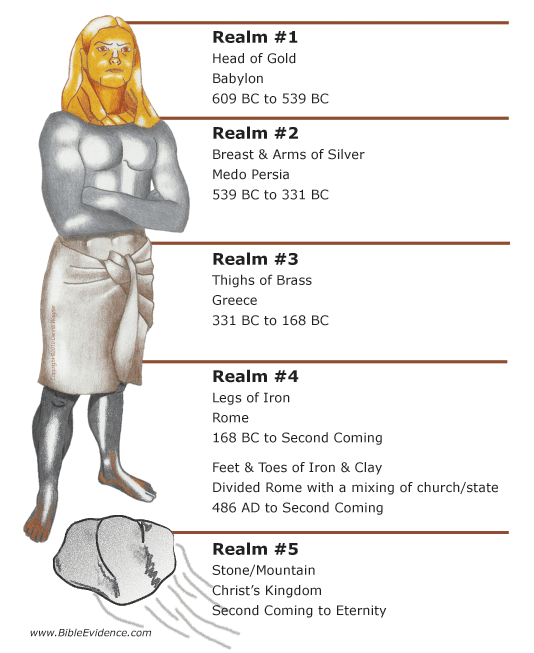
According to most Bible scholars, the legs of iron represent the Roman Empire. That Kingdom is also described in Daniel Chapter 7. “After this I saw in the night visions, and behold, a fourth beast, dreadful and terrible, exceedingly strong. It had huge iron teeth; it was devouring, breaking in pieces, and trampling the residue with its feet. It was different from all the beasts that were before it, and it had ten horns.” Daniel 7:7 (NKJV). This description of the fourth world empire is an elaboration of what the prophet Daniel briefly refers to in Daniel Chapter 2. “You, O king, were watching; and behold, a great image! This great image, whose splendor was excellent, stood before you; and its form was awesome. This image’s head was of fine gold, its chest and arms of silver, its belly and thighs of bronze, its legs of iron, its feet partly of iron and partly of clay.” Daniel 2:31-33 (NKJV).  The empires of antiquity are here represented as

1. The Head of Gold (Babylon),

2. The Arms and Breast of Silver (Medo Persia),

3. The Belly and Thighs of Brass (Greece),

4. The Legs of Iron (Pagan Rome)

5. The Feet of Iron and Clay.

The feet of iron and clay are an attempt by the divine mind to represent a broad sweep of history. In 330 AD, the Roman Emperor Constantine the Great moved the seat of his empire from Rome to the City of Byzantium and renamed that City Constantinople. That event was the beginning of the Byzantine Empire. The prophet Daniel refers to a little horn that came up among the ten horns of the dragon, which most Bible scholars agree represents the Roman Empire. “I was considering the horns, and there was another horn, a little one, coming up among them, before whom three of the first horns were plucked out by the roots. And there, in this horn, were eyes like the eyes of a man and a mouth speaking pompous words.” Daniel 7:8 (NKJV).

(TO BE CONTINUED)