The BRIC movement was inaugurated fifteen years ago on June 16th, 2009. The original members were Brazil, Russia, India, and China. The Republic of South Africa joined in 2010 when the organization became BRICS (Brazil, Russia, India, China, and South Africa). Presently, “BRICS is an intergovernmental organization comprising Brazil, Russia, India, China, South Africa, Iran, Egypt, Ethiopia and the United Arab Emirates. Originally identified to highlight investment opportunities, the grouping evolved into a geopolitical bloc, with their governments meeting annually at formal summits and coordinating multilateral policies since 2009. Relations among BRICS are conducted mainly based on non-interference, equality and mutual benefit.” BRICS, WIKIPEDIA, The Free Encyclopedia.
- BRICS countries have increased their share of global GDP threefold in the past 15 years.
- BRICS’ share of global output will increase from18% (according to market exchange rates), to 25% to 26% over the next 10 years and even to one-third by 2030.
- BRICS countries occupy 30% of the global territory.
- They are home to 45% of the world’s population.
- The contribution to global economic growth over the last decade has reached 50%, which makes this group of states the leading power in global economic development.
- BRICS accounted for approximately 11% of global annual foreign direct investment (FDI) flows in 2012 (US$465 billion).
- BRICS account for 17% of world trade.
- BRICS’ combined foreign reserves are estimated at US$4 trillion.
- Some analysts predict that BRICS could become as big as the Group of 7 (the United States of America [USA], Japan, Germany, France, Britain, Canada and Italy) by 2027. SOUTH AFRICAN GOVERNMENT (GOV.ZA): Fifth BRICS Summit, General Background.
From the appearance of things, BRICS has a very bright future. But how do the BRICS prospects compare with prophetic pronouncements? For example, the prophet Daniel references the Kings that would exist at the end of time. The BRICS phenomenon is not mentioned in his prophecies, which, by any standard, is definitely not a good sign for that movement.
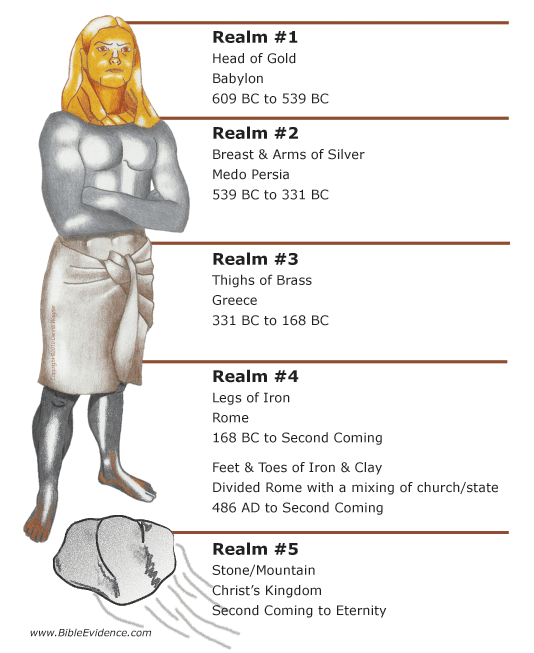
According to most Bible scholars, the legs of iron represent the Roman Empire. That Kingdom is also described in Daniel Chapter 7. “After this I saw in the night visions, and behold, a fourth beast, dreadful and terrible, exceedingly strong. It had huge iron teeth; it was devouring, breaking in pieces, and trampling the residue with its feet. It was different from all the beasts that were before it, and it had ten horns.” Daniel 7:7 (NKJV). This description of the fourth world empire is an elaboration of what the prophet Daniel briefly refers to in Daniel Chapter 2. “You, O king, were watching; and behold, a great image! This great image, whose splendor was excellent, stood before you; and its form was awesome. This image’s head was of fine gold, its chest and arms of silver, its belly and thighs of bronze, its legs of iron, its feet partly of iron and partly of clay.” Daniel 2:31-33 (NKJV). The empires of antiquity are here represented as
1. The Head of Gold (Babylon),
2. The Arms and Breast of Silver (Medo Persia),
3. The Belly and Thighs of Brass (Greece),
4. The Legs of Iron (Pagan Rome)
5. The Feet of Iron and Clay.
The feet of iron and clay are an attempt by the divine mind to represent a broad sweep of history. In 330 AD, the Roman Emperor Constantine the Great moved the seat of his empire from Rome to the City of Byzantium and renamed that City Constantinople. That event was the beginning of the Byzantine Empire. The prophet Daniel refers to a little horn that came up among the ten horns of the dragon, which most Bible scholars agree represents the Roman Empire. “I was considering the horns, and there was another horn, a little one, coming up among them, before whom three of the first horns were plucked out by the roots. And there, in this horn, were eyes like the eyes of a man and a mouth speaking pompous words.” Daniel 7:8 (NKJV).
(TO BE CONTINUED)

 aadventuresinghana.wordpress.com