What exactly is the full import of this prophecy? It was given during the duration of the Jewish exile from the promised land, while they were still in Babylon. The second temple, built by King Herod was still standing, when Jesus cleansed it twice. The first cleansing was executed at the beginning of Christ’s Ministry in 27 A.D., and the second cleansing occurred in 31 A.D., shortly before His crucifixion. This prediction by Daniel the prophet, couldn’t have been referring to either of the cleansings administered by The Saviour. Because the time frames of those cleansings do not coincide with the 2300-day time period. Which most Bible scholars believe to have commenced in 457 B.C. As can be clearly seen from the chart provided, exactly 486 years transpired from the promulgation of Emperor Artaxerxes’ decree, for the restoration and rebuilding of Jerusalem, and the crucifixion of The Messiah.
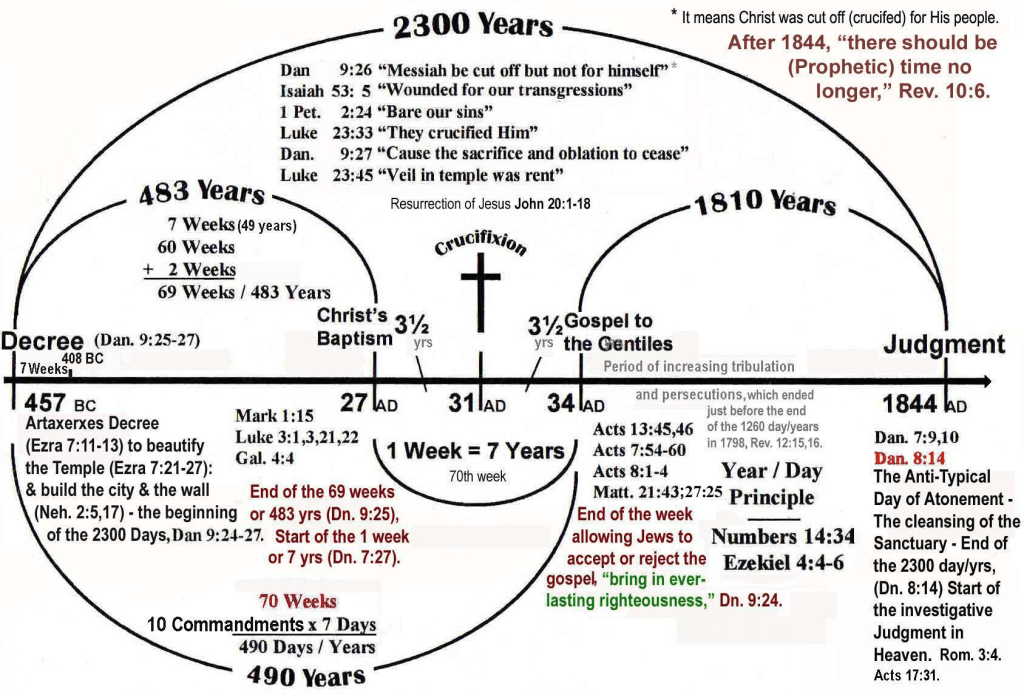
The attentive reader needs to be appraised of the fact that according to scripture one day of prophetic time represents one full year. This principle is clearly established in God’s Word. “According to the number of the days in which you spied out the land, forty days, for each day you shall bear your guilt one year, namely forty years, and you shall know My rejection. I the Lord have spoken this. I will surely do so to all this evil congregation who are gathered together against Me. In this wilderness, they shall be consumed, and there they shall die.” Numbers 14:34-35. (NKJV). Accordingly, the 2300 days time period represents 2300 years. That time period commenced in 457 B.C. This same prophetic principle is clearly demonstrated in the writings of the prophet Ezekiel. “Lie also on your left side, and lay the iniquity of the house of Israel upon it. According to the number of the days that you lie on it, you shall bear their iniquity. For I have laid on you the years of their iniquity, according to the number of the days, three hundred and ninety days; so you shall bear the iniquity of the house of Israel. And when you have completed them, lie again on your right side; then you shall bear the iniquity of the house of Judah forty days. I have laid on you a day for each year.” Ezekiel 4:4-6. (NKJV). Let us all solemnly contemplate the fact that The Lord Almighty exists within eternity. Therefore, it is consistent with His sovereignty, for Him, to carve out large periods of time to accomplish His purposes as He sees fit.
The earthly sanctuary constructed in Jerusalem ceased to have meaning and relevance after the death of Christ. It was meant to exist only for a limited period of time until the era arrived for it to be superseded by things that were far superior. Because the Saviour ascended to heaven to minister to the needs of His people from that vantage point. “Now this is the main point of the things we are saying: We have such a High Priest, who is seated at the right hand of the throne of the Majesty in the heavens, a Minister of the sanctuary and of the true tabernacle which the Lord erected, and not man.” Hebrews 8:1-2 (NKJV). This was the same Saviour through whom all the disciples prayed after the destruction of Jerusalem and the annihilation of The Jewish Temple and all it represented. During the first two hundred years of the early Christian Church. While it struggled for its survival in the Greco-Roman world the most prominent and enduring experience of the early Christian believers was persecution. Believers had come to accept suffering. Since Christ had died on the cross there was no higher honor than martyrdom. “The early church’s theology of martyrdom was born not in synods or councils, but in sunlit, blood-drenched coliseums and catacombs, dark and still as death. The word martyr means “witness” and is used as such throughout the New Testament. However, as the Roman Empire became increasingly hostile toward Christianity, the distinctions between witnessing and suffering became blurred and finally nonexistent.” (How The Early Church Viewed Martyrs by William G. Bixler).
The early Christians were mighty warriors of the Christian faith. We are able to read all about their missionary exploits and victories not only in the four Gospels but also in the book of Acts and the Epistles. The Master had lived a powerful life and what he did and taught was carried on by His successors. Their work was so successful that millions worldwide in the twenty-first century still continue to embrace and live the Christian faith. “During the years following the Pentecostal experience, considerable progress had been made. Quite a number of Christian groups or churches had been established, several important Christian doctrines had been formulated, and the Gospel message had been carried to many parts of the world. But immediately following the martyrdom of Paul, a number of serious problems arose; these not only tended to check the growth but also threatened the very existence of the Christian church. It was in an attempt to meet and solve these problems, that several New Testament books were written.” (A Study Of The New Testament by Herbert Hunt).

 aadventuresinghana.wordpress.com